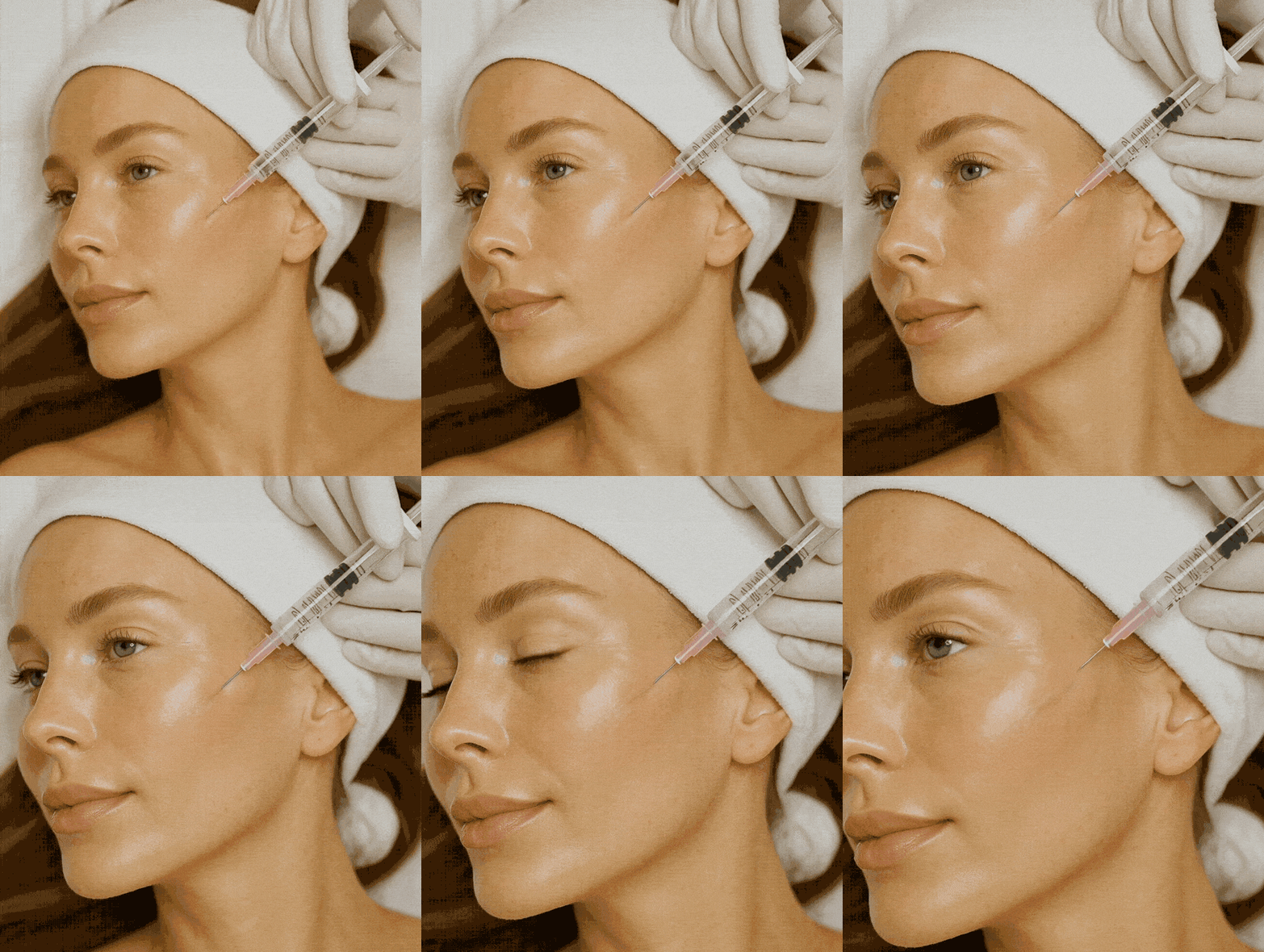

Breakouts eventually clear, but the marks they leave behind can stay for years. Pitted texture and uneven contours often show most in bright light and rarely fade on their own.
The good news is that several professional treatments can soften the look of scarring. The best treatments for acne scars depend on what kind of scars you have, how deep they go, your skin tone, and how much recovery time fits your life. Below, we compare fractional CO₂ laser resurfacing, RF microneedling, traditional microneedling, and platelet-rich plasma (PRP).
Understanding Different Types of Acne Scars
Before choosing among acne scar treatment options, it helps to know what you’re treating. Each scar shape responds to treatment differently.
- Atrophic scars sit below the surrounding skin. They develop when inflammation breaks down collagen, and the skin can’t fully rebuild the lost support.
- Ice pick scars are small, narrow openings that reach deep into the skin, like a tiny puncture.
- Boxcar scars are wider depressions with sharp, defined walls and a flatter base.
- Rolling scars create soft dips and waves across the skin. Bands of tissue below the surface often pull the skin downward.
- Hypertrophic and keloid scars are raised. They form when the skin produces too much collagen during healing.
Not every mark left by acne is a true scar. Flat brown spots (post-inflammatory hyperpigmentation) and lingering pink or red patches change the skin’s color, not its surface. These often need a different plan than depressed or raised scars.
What Are the Best Treatments for Acne Scars?
Most professional acne scar treatments share one goal: prompting the skin to build new collagen so depressed areas look fuller and smoother. They differ in how they deliver that signal and how deeply they work.
Solaria Fractional CO₂ Laser for Acne Scars
A fractional CO₂ laser sends thin beams of energy into the skin in a grid-like pattern. Each beam vaporizes a narrow column of tissue and heats the surrounding area, while the skin between columns stays untouched. As those columns heal, the skin replaces damaged tissue and lays down fresh collagen.
Using a CO₂ laser for acne scars can be especially helpful for depressed scars and rough, irregular texture because it works on the surface and the deeper layers at the same time. For patients with moderate or more noticeable scarring, this more intensive approach may produce visible change in fewer visits than gentler options, though that depends on the person.
That strength comes with recovery. Expect redness, peeling, and a period of sensitive skin while you heal, so it helps to know what to expect during CO₂ laser recovery before booking. Careful sun protection matters throughout. Because ablative lasers carry a risk of pigment changes, your provider will review your skin tone and history before choosing settings. Solaria is one of several different types of laser resurfacing, with depth and density tailored to your skin.
RF Microneedling for Acne Scars
RF microneedling pairs fine needles with radiofrequency energy. The needles open tiny channels, and the energy heats the tissue beneath the surface to encourage remodeling from within. Morpheus8 is one example, often chosen for acne scars, uneven texture, and enlarged pores.
The main difference from a CO₂ laser is that RF microneedling does not remove surface tissue. It works below the top layer, so recovery is often lighter, with improvement building gradually over a series of treatments. Downtime and results still depend on needle depth, energy settings, and how your skin responds.
Traditional Microneedling for Acne Scars
Traditional microneedling uses fine needles alone, without added heat. The tiny punctures trigger the skin’s repair process, supporting collagen production and gradual smoothing.
Microneedling for acne scars is often a good fit for milder textural scarring and overall skin quality. Most people need several sessions spaced apart, and results develop slowly. Compared with RF microneedling, the traditional approach is gentler because it lacks thermal energy, but it may do less for deeper scars. Neither suits every scar type, and good microneedling aftercare helps the skin heal well.
PRP for Acne Scars
PRP comes from a small sample of your own blood. It is spun to concentrate platelets and growth factors, then applied to the skin or injected.
PRP for acne scars is usually used as a supporting step rather than a standalone fix. Paired with microneedling or another procedure, it may help the skin’s healing response. Research results are mixed, and PRP does not change the structure of deep, established scars on its own. It works best within a plan that also addresses scar shape and depth. Understanding how PRP injections work can help you decide whether it belongs in your plan.
CO₂ Laser vs. RF Microneedling for Acne Scars
When people compare CO₂ laser vs. RF microneedling for acne scars, the right choice usually comes down to the scars themselves and how much downtime you can manage.
| Factor | Fractional CO₂ Laser | RF Microneedling |
|---|---|---|
| How it works | Removes narrow columns of surface tissue and heats deeper layers | Delivers heat below the surface through fine needles |
| Scar severity | May suit selected patients with more pronounced surface irregularities | May suit certain mild to moderate textural concerns |
| Downtime | Generally more recovery | Generally lighter recovery |
| Sessions | Noticeable change may take fewer visits for some patients | Commonly planned as a series |
| Skin considerations | Pigmentation risk must be assessed carefully | Skin tone and sensitivity still guide settings |
Neither treatment wins in every case. The trade-offs between Solaria CO₂ laser and Morpheus8 come down to your scar types, skin tone, hyperpigmentation history, desired improvement, and schedule.
CO₂ Laser vs. Microneedling for Acne Scars
The CO₂ laser vs. microneedling acne scars question follows a similar pattern. Traditional microneedling is often considered for lighter textural concerns and a gradual series with minimal downtime. A CO₂ laser may be considered when the skin needs more substantial resurfacing.
Some scars don’t respond fully to either one. Rolling scars held down by bands of tissue, and deep ice pick scars, may need targeted methods that release or lift the scar directly. Depressed scars are not all alike, which is why the type matters as much as the tool.
What Is the Best Treatment for Deep Acne Scars?
No one procedure works best for every deep scar. The right approach depends on the scar’s shape, its depth, whether tissue underneath is tethering it down, and your skin characteristics.
Fractional CO₂ laser resurfacing may help selected depressed scars and uneven surface texture. Deep ice pick scars or tethered rolling scars, however, may call for techniques such as punch excision or subcision, performed by an appropriately qualified clinician. A staged combination plan often works best. Progress builds slowly, and complete removal of established scars can’t be promised.
How to Get Rid of Acne Scars: Choosing the Right Treatment Plan
If you’re wondering how to get rid of acne scars, start with a personalized treatment plan rather than a single procedure. The right approach depends on your scar type, skin tone, current acne activity, and goals.
- Schedule a consultation: A provider can assess your scar types, skin health, and which acne scar treatment options may be appropriate.
- Discuss your skin history: Share any current or recent breakouts, medications, past procedures, and history of pigmentation changes or unusual scarring. As discussed in our guide to skin treatments for darker skin tones, skin tone can influence treatment selection and the risk of post-treatment pigmentation.
- Set realistic expectations: Ask about the improvement you may see, the recommended number of sessions, costs, and recovery time.
- Follow aftercare instructions: Protect treated skin from UV exposure and follow your provider’s guidance to support healing.
- Manage active acne: Keeping breakouts under control can help reduce the risk of developing additional scars.
Skincare alone generally cannot eliminate established textural acne scars, although a consistent routine can support skin health and help improve lingering discoloration between professional treatments.
Explore Acne Scar Treatments at Evexia Medspa
Acne scars respond best to a plan built around your skin. Solaria fractional CO₂ laser resurfacing may suit more noticeable texture, Morpheus8 offers remodeling with lighter recovery, traditional microneedling supports milder concerns, and PRP can complement other procedures.
As a leading provider of Solaria CO₂ laser resurfacing in McLean, VA, Evexia Medspa also offers Morpheus8 RF microneedling, traditional microneedling treatments, and PRP skin rejuvenation. We serve Northern Virginia and Washington, D.C., including Tysons Corner, Arlington, Falls Church, Vienna, and Great Falls. Explore acne scar treatments at Evexia Medspa, or call (571) 609-3375 to find a plan that fits your goals.
Acne Scar Treatment FAQs
Can I treat acne scars while I still have breakouts?
It depends on the treatment. Many resurfacing and needling procedures are postponed while acne is active, so your provider may suggest getting breakouts under control first.
How soon will I see results from acne scar treatment?
Most improvement appears gradually as collagen rebuilds over the following months. Timing varies by treatment, intensity, and how your skin heals.
Can I combine more than one acne scar treatment?
Yes, when it’s clinically appropriate. Many plans pair or stage treatments, such as resurfacing with PRP or needling, to address different parts of the scarring.