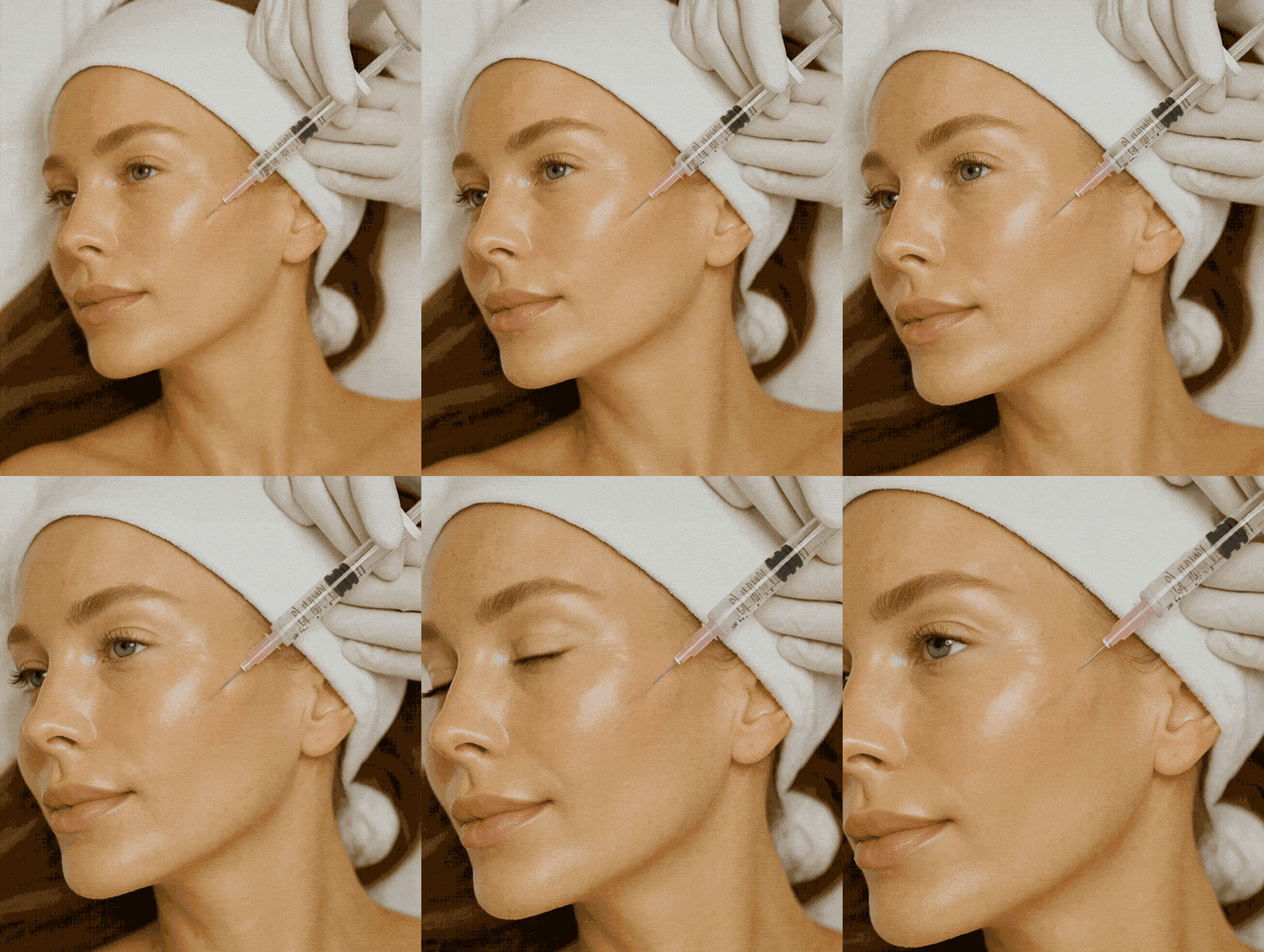


“How many units of Botox do I need?” It’s one of the most common questions patients ask before their first treatment. While it’s understandable to look for a simple number, the answer isn’t the same for everyone. The amount of Botox needed depends on factors like your facial anatomy, muscle strength, treatment area, and the results you hope to achieve.
For example, two people treating forehead lines may require different numbers of units to achieve equally natural-looking results. That’s because Botox is designed to relax muscles, not erase wrinkles according to a standard formula.
This guide explains how many units of Botox are typically used in different treatment areas, what factors influence your dosage, and why an individualized treatment plan is key to safe, balanced, and natural-looking results.
Key Takeaways
- Botox dosage is personalized. Your ideal number of units depends on your muscles, anatomy, and goals.
- More isn’t better. The right dose creates natural-looking results without overfreezing your expression.
- Every treatment area is different. Areas like the forehead, crow’s feet, and masseters require different unit ranges.
- Expert technique matters. An experienced injector tailors your treatment for safe, balanced, and beautiful results.
What Is a Botox Unit?
Before discussing how many units of Botox you may need, it helps to understand what a Botox unit actually measures. Unlike dermal fillers, which are measured by the syringe, Botox is measured in units, which indicate the amount of botulinum toxin used during treatment.
Each unit represents a standardized measure of the medication’s potency, allowing providers to tailor treatment to the muscles being treated rather than simply injecting a fixed amount into every patient.
Why Unit Count Matters
One of the biggest misconceptions about Botox is that more units produce better results. In reality, the goal is to use the appropriate number of units to relax targeted muscles while preserving natural facial movement. Too few units may not provide the desired improvement, while too many can limit expression and create an overtreated appearance.
This is why experienced injectors evaluate more than just visible wrinkles. They also assess your facial anatomy, muscle strength, and how your muscles move when you smile, frown, or raise your eyebrows. Those factors play a much larger role in determining your Botox dosage than wrinkle depth alone.
What Affects How Many Botox Units You Need?
The question of what affects how many Botox units you need involves multiple interconnected factors that make each treatment unique. Understanding these variables helps explain why there’s no universal answer to how many units of Botox is normal for everyone.
Muscle Strength and Facial Anatomy Influence Your Dosage
Your facial muscle strength plays the most significant role in determining your ideal unit count. Some people naturally have stronger, more active muscles that require additional units to achieve the same level of relaxation as someone with less muscular activity. This variation is completely normal and doesn’t indicate any problem with your treatment.
Facial anatomy also varies considerably between individuals. The size, shape, and positioning of your muscles affect how Botox spreads and how many units are needed for optimal coverage. Your injector will evaluate these anatomical differences during your consultation to create a treatment plan that works harmoniously with your unique facial structure.
Age, Gender, and Wrinkle Severity: Customizing Your Units
Age influences muscle tone and skin elasticity, which can affect your treatment plan. Younger patients might need fewer units to prevent early lines from deepening, while those with established wrinkles may require a more comprehensive approach. However, age alone doesn’t determine dosage since muscle strength varies widely regardless of chronological age.
Gender significantly impacts treatment planning because how many units of Botox men need typically exceeds what women require. Men generally have larger, stronger facial muscles that need more units to achieve similar results. Male patients often require 20-30% more units than women treating the same areas.
The severity of your dynamic wrinkles provides important information, but it doesn’t solely dictate the unit count. Deep lines might indicate strong muscle activity, but your injector will focus more on observing how your muscles move during facial expressions to determine the most effective treatment approach.
Previous Botox Experience and Your Desired Outcome
Your treatment history influences your current needs in several ways. If you’ve had Botox before, your injector will consider how you responded to previous treatments, how long results lasted, and whether you were satisfied with the level of muscle relaxation achieved.
Your aesthetic goals significantly impact treatment planning. Patients seeking how many units of Botox for a natural look will have different requirements than those wanting maximum wrinkle reduction. Some prefer to maintain subtle facial movement, while others want more dramatic smoothing. Communicating your preferences clearly helps your injector customize your treatment accordingly.
Botox Units by Area
When exploring Botox units by area, it’s crucial to understand that the following ranges represent general guidelines rather than fixed prescriptions. Every patient’s anatomy and goals are unique, making individualized assessment essential for optimal results. This Botox dosage by area information should help you understand typical treatment ranges while recognizing that your actual needs may vary.
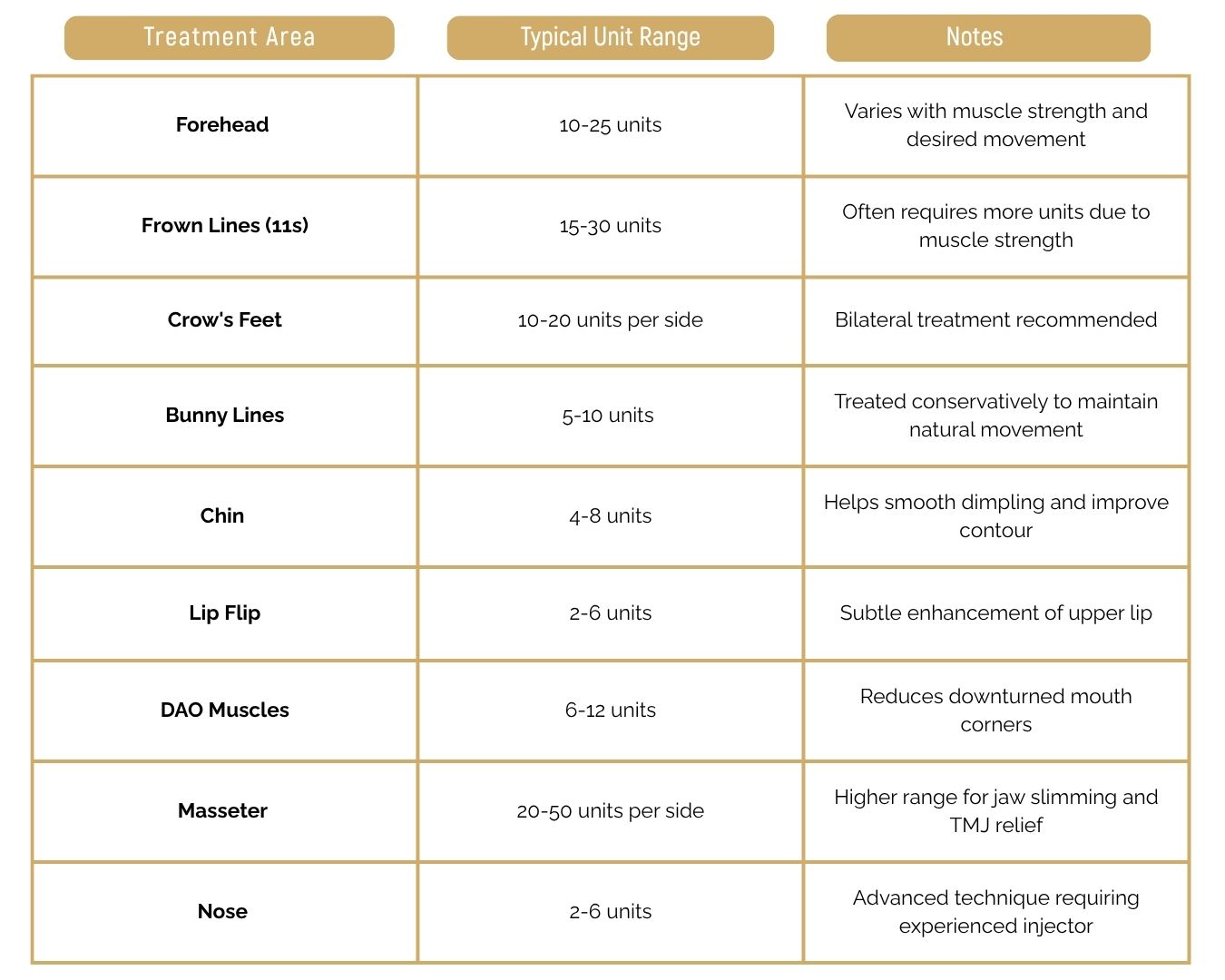
Please note: These ranges are general guidelines only. Your treatment plan will be customized during your consultation based on your individual anatomy, muscle strength, and aesthetic goals.
Remember that combining multiple areas often creates the most harmonious results. Many patients find that treating related muscle groups together produces more balanced, natural-looking outcomes than addressing isolated areas.
How Many Units of Botox for the Forehead?
Most patients receive 10 to 25 units of Botox for the forehead, although the exact number depends on your facial anatomy, muscle strength, and treatment goals. If you’re wondering how many units of Botox do I need for forehead lines, there isn’t a one-size-fits-all answer.
Why Forehead Botox Is Customized
The forehead doesn’t work independently. Its muscles interact closely with the glabellar muscles that create the “11 lines” between your eyebrows, so experienced injectors evaluate both areas together to maintain natural movement and balanced brow positioning.
Your recommended dosage may also vary based on:
- The strength of your forehead muscles
- The depth of your lines
- Your natural brow position
- Whether you prefer subtle movement or a smoother appearance
Because Botox cannot be reversed once injected, many first-time patients start with a conservative treatment plan that can be adjusted at a follow-up appointment if needed.
How Many Units of Botox for 11 Lines?
Treating the “11 lines” between the eyebrows typically requires 15 to 30 units of Botox, although the exact number depends on your muscle strength and treatment goals. If you’re wondering how many units of Botox for frown lines between the eyebrows, your injector will determine the appropriate dosage during your consultation.
Why the 11s Often Requires More Units
The muscles that create the 11 lines, known as the glabellar muscles, are among the strongest and most active muscles in the face. Because they’re used every time you frown, squint, or concentrate, they often require more Botox than other treatment areas.
Your recommended dosage may vary based on:
- The strength of your glabellar muscles
- The depth of your frown lines
- Your facial anatomy
- Whether you want to preserve more natural movement
The goal isn’t to eliminate every facial expression. Instead, Botox is carefully dosed to soften frown lines while allowing you to maintain a natural, expressive appearance.
How Many Units of Botox for Crow’s Feet?
Most patients receive 10 to 20 units of Botox per side to treat crow’s feet, though the exact dosage varies based on your facial anatomy and muscle activity. If you’re wondering how many units of Botox do you need for crow’s feet, your provider will recommend a personalized treatment plan based on your goals and the severity of your lines.
What Affects Your Dosage?
Crow’s feet are typically treated bilaterally to maintain facial symmetry. Your recommended dosage may vary based on:
- The strength of the muscles around your eyes
- The depth of your crow’s feet
- Whether you’re treating early fine lines or more established wrinkles
- How much natural movement you’d like to preserve
The goal is to soften wrinkles while maintaining a warm, expressive smile. A skilled injector will customize your treatment to create refreshed, natural-looking results rather than eliminating every line around the eyes.
How Many Units of Botox for Masseter Botox?
Masseter Botox typically requires 20 to 50 units per side, making it one of the higher-dose Botox treatments. If you’re wondering how many units of Botox for jaw slimming, the exact number depends on the size and strength of your jaw muscles, as well as whether your treatment is cosmetic or therapeutic.
Why Does Masseter Botox Require More Units?
Unlike the smaller muscles that create facial wrinkles, the masseter is one of the strongest muscles in the body. Because it’s responsible for chewing and clenching, it generally requires more Botox to achieve the desired result.
Treatment may be recommended to:
- Slim a wide or square jawline
- Reduce teeth grinding (bruxism)
- Relieve jaw tension or TMJ-related discomfort
- Improve facial balance by softening the lower face
Whether your goal is jaw slimming or relief from chronic clenching, your provider will recommend a customized dosage based on your anatomy and treatment objectives.
Do First-Time Botox Patients Need Fewer Units?
Many people assume first-time Botox patients automatically need fewer units, but that’s not always the case. Your dosage is determined by factors such as muscle strength, facial anatomy, and treatment goals, not by whether you’ve had Botox before.
That said, many providers take a conservative approach with new patients by focusing on natural-looking results and evaluating how your muscles respond to treatment. Future appointments can then be adjusted if needed.
If you’re wondering how many Botox units does a first timer need or how many units of Botox for a natural look, the answer is different for everyone. The goal is to use the appropriate number of units to soften wrinkles while preserving natural facial movement, regardless of whether it’s your first treatment or your tenth.
Can You Combine Botox Treatments?
Yes. Many patients choose to treat multiple areas during the same appointment to create more balanced, natural-looking results. Because facial muscles work together, addressing related areas simultaneously can help maintain harmony and preserve natural facial expressions.
Common treatment combinations include:
- Forehead, 11 lines, and crow’s feet for comprehensive upper-face rejuvenation
- DAO muscles and the chin to soften a downturned mouth and improve chin dimpling
- The nose and glabella to address bunny lines and frown lines together
- Masseter Botox with other lower-face treatments for jaw slimming, teeth grinding, or facial balancing
The best combination depends on your facial anatomy, concerns, and treatment goals. During your consultation, your provider can recommend a personalized plan that enhances your features while maintaining a natural appearance.
Getting Great Botox Results Isn’t About More Units
When it comes to Botox, more units don’t necessarily mean better results. The right dosage, combined with precise injection technique and a thorough understanding of facial anatomy, is what creates smooth, natural-looking outcomes.
An experienced injector customizes your treatment based on your muscle movement, facial structure, and aesthetic goals. Careful placement is just as important as the number of units used, helping soften wrinkles while preserving natural expression.
Because some treatment areas require a high level of precision, choosing a qualified provider is essential. If you’d like to learn more about why technique matters, explore our guide on 5 Dangerous Botox Zones: What to Ask For and What to Avoid.
What to Expect After Botox
Botox doesn’t work immediately, so it’s important to know what to expect after treatment. Most patients begin to notice results within 3 to 5 days, with full results developing in about 2 weeks.
It’s normal to experience mild redness, swelling, or tenderness at the injection sites, but these effects typically resolve quickly. Following your provider’s aftercare instructions can help support optimal healing and results.
Botox typically lasts 3 to 4 months, although the exact duration varies based on factors like your metabolism, muscle strength, and the treatment area. Regular maintenance appointments can help keep your results looking consistent over time.
If you’re preparing for treatment, our Best Botox and Filler Recovery Tips guide explains how to care for your injections after your appointment. You can also learn How to Make Botox Results Last Longer with simple habits that help maximize your results.
Finding the Right Botox Dosage for You
There is no single “normal” number of Botox units that works for everyone. The right dosage depends on your facial anatomy, muscle strength, treatment area, and aesthetic goals.
While Botox unit guides can provide general information, they cannot account for the individual factors that influence your treatment. The most natural-looking results come from a personalized approach that combines precise dosing, expert injection technique, and a thorough understanding of facial anatomy.
If you’re searching for Botox units in McLean, VA, choosing an experienced injector who prioritizes safety and natural-looking results is the most important step. A consultation allows your provider to evaluate your unique needs and create a treatment plan that helps you look refreshed while maintaining your natural expressions.
Ready to learn what Botox treatment is right for you? Schedule a consultation to discuss your goals and receive a customized recommendation.